

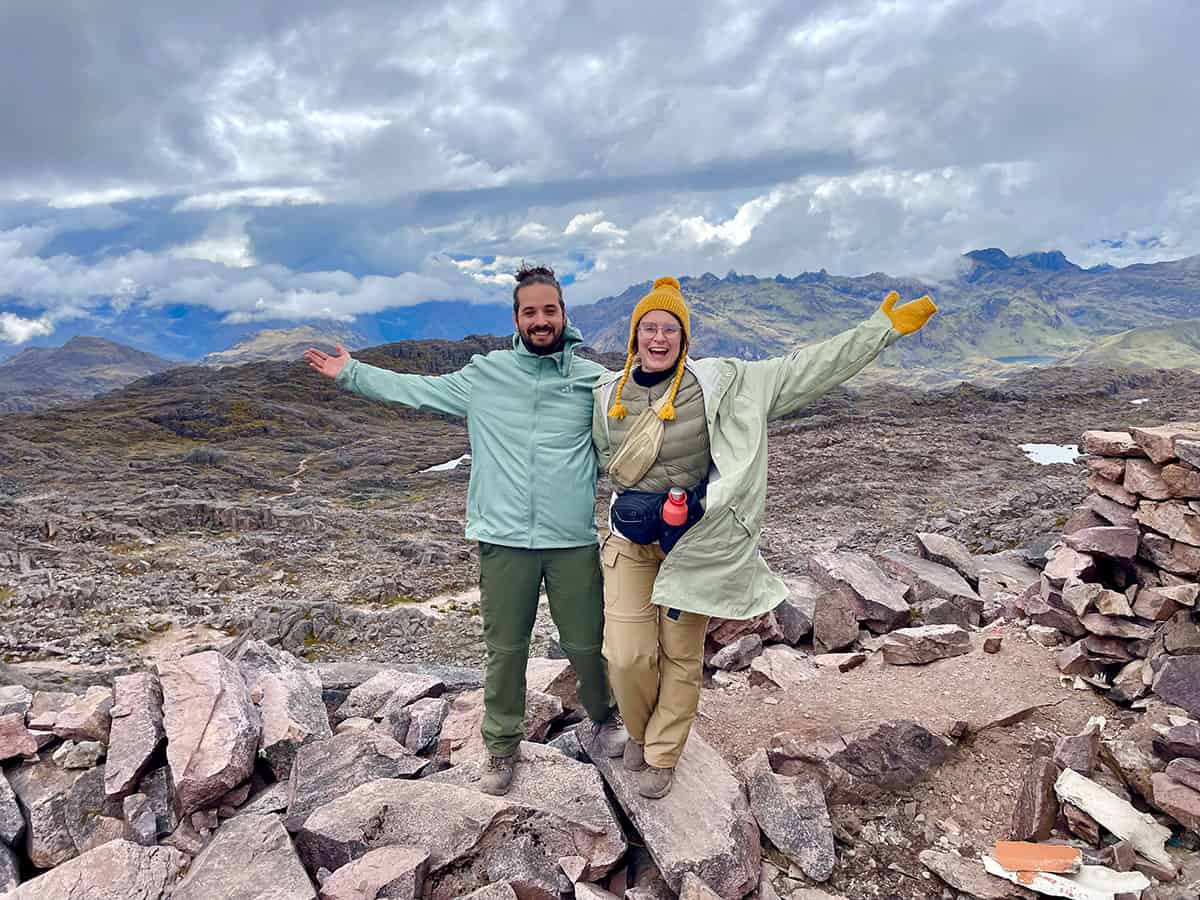
In the summer of last year you would have found me halfway up a mountain in the heart of Peru, gasping for what little air the altitude offered as the lactic acid built up in my oxygen-depleted muscles.
Okay, maybe it wasn’t all as dramatic as that but for me it was a hell of an adventure.
Little did I know, the real adventure hadn’t even begun…
We were a couple of days into our hike, returning from the cloud city of Machu Picchu before heading deep in the Amazon Rainforest, when I started to feel a sharp pain in my gut.
I put it down to some dodgy food and suffered through an agonising night of little sleep.
In the morning, I was as pale as a sheet and my partner called a doctor.
“Hopefully it’s typhoid,” the doctor said.
Brilliant… That’s best case is it?
“Typhoid is easy to cure. What we don’t want is your appendix bursting.”
After several tests, it confirmed that indeed my appendix was bursting and I was rushed into emergency surgery.
Had I waited any longer, had I braved the pain and stupidly pushed on into the rainforest, we would have been three hours by canoe from the nearest airport and I probably wouldn’t be writing this now.
So we were incredibly fortunate to have been in a city with a hospital but even still… I didn’t speak the language; I didn’t know whether this was a good hospital; and no part of me was prepared for what was happening.
This was not the adventure we had planned and the uncertainty of my predicament was terrifying.
An increasingly uncertain world
A study we commissioned earlier in the year found that 73% of UK office workers reported frequent or significant change at work but only 26% of people not in a management role are feeling optimistic about it.
That makes for a pretty distressing reality.
Just take a look at this graph from the World Uncertainty Index which records the percent of word “uncertain” in the Economist Intelligence Unit country reports. This trend is what statistician’s call “f*cking bonkers”.

Okay so they might not use that exact language but the military does actually have a word for it. The world is VUCA: Volatile, Uncertain, Complex and Ambiguous.
It’s all VUCA’d up.
Humans aren’t very good at dealing with uncertainty. I know I’m not.
My brain wants to plan five steps ahead, anticipate every possible route and predict every possible outcome so that I, my team and my loved ones will be safe.
My brain basically wants a map.
It makes sense why. Maps offer certainty, order and the feeling that we can control the journey ahead.
On the mountain I had a map. Well, I actually had a guide but they had a map.
I also had a mental map for how I had envisioned this whole holiday going. Ending up in hospital was not an outcome I had planned.
In the hospital I was without a map, without a guide and that uncertainty was awful.
And that is the issue with maps.
Maps quickly become outdated when the world changes – and the world is changing faster than ever before and becoming more uncertain than ever.
To navigate this uncertainty, we don’t need a better map, we need a different model altogether.
From Map to Compass
When we’re experiencing uncertainty it’s like we’re surrounded by fog. There’s a lot unknown to us and we can’t see the full picture.
We see shapes and shadows and what ends up happening is that we fill in the gaps with stories.
Humans hate uncertainty and so we try and manufacture certainty by predicting what might happen. The only issue is that these stories aren’t always accurate.
At work this can have dire consequences as the rumour mill runs wild.
Many leaders naturally wait until they have more information to share – they wait until they have clarity on a new map to share – but this simply makes things worse.
We need a mindset shift: from map to compass.

A compass doesn’t give you the entire route or promise certainty. But it does offer something more powerful in times of ambiguity: direction.
With a compass, you can still move forward, even without knowing every twist and turn.
If we cling to the idea of a map – a rigid plan with all the answers – we flounder when challenges hit. With a compass mindset, we can keep moving even as things change.

This is a concept we regularly share with leaders all around the world navigating teams through change and uncertainty.
This isn’t to say that maps and planning aren’t useful, but you don’t need to chart the whole journey before you begin and you certainly don’t want to remain rigid when the map becomes outdated.
When the timelines change. When challenges disrupt the strategy. When a change within the C-Suite threatens to grind everything to a halt.
We talk about the idea of Compass Communication and encourage leaders to translate their default map responses – those that over-promise certainty or delay the conversation – into a compass.
🗺️ “I’ll get back to you once I have the full picture.”
🧭 “Here’s what I know so far, and here’s what I’m still figuring out. I’ll keep you posted as it develops.”
🗺️ “Don’t worry, this is all under control.”
🧭 “There’s still some uncertainty over XYZ, but here’s how we’ll handle it as it unfolds.”
🗺️ “This won’t really affect us, things should stay the same.”
🧭 “It’s not clear yet whether this will affect us. As soon as I have new information I will share it with you.”
In a volatile world where the map keeps changing, it’s a compass that can keep us moving. And in my case, a successful appendix operation…